The Invisible Rules Behind Successful Business with China
Doing business with China today is rarely a question of if — it is a question of how well.

Business Relations in China
Introduction
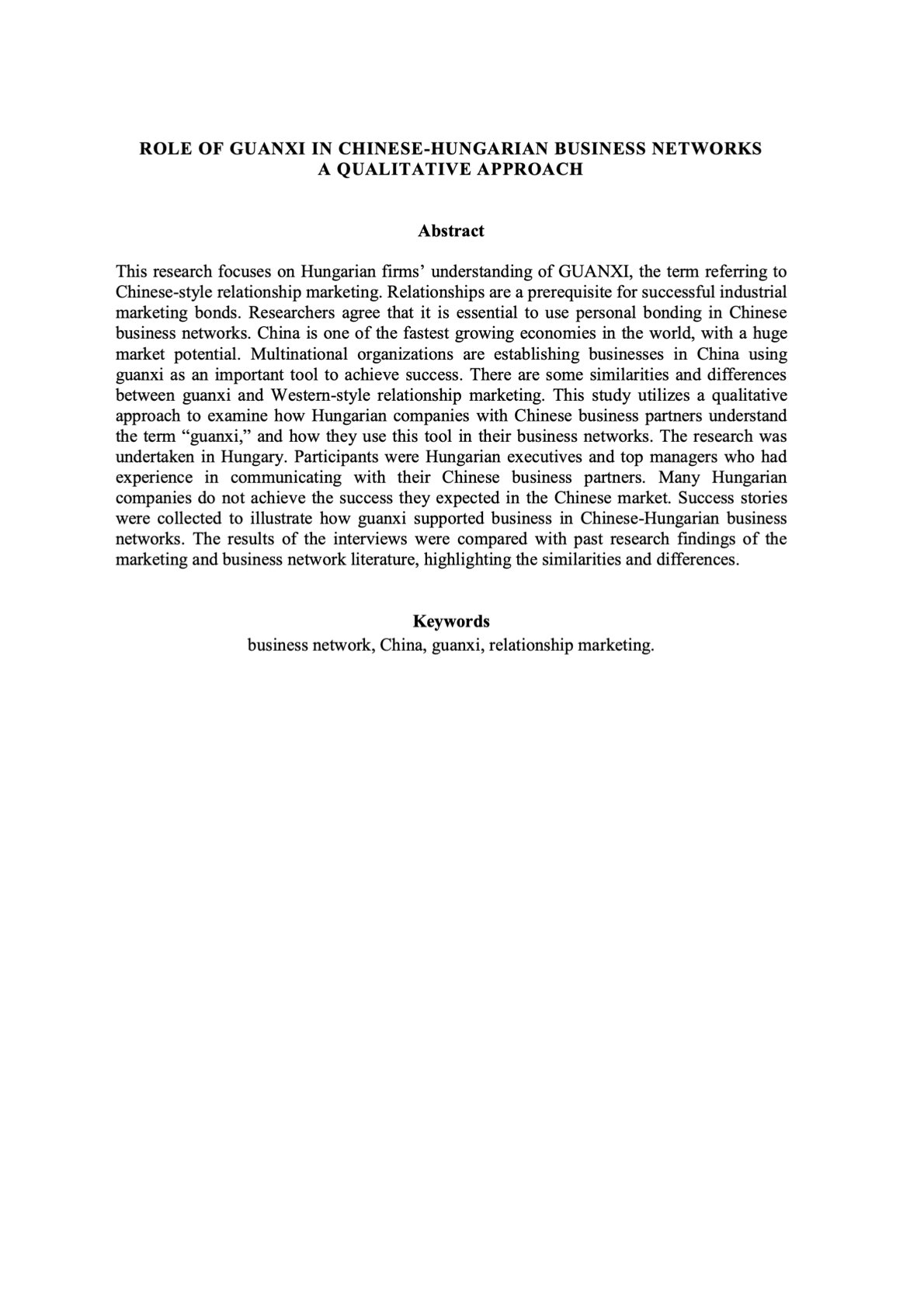
This post is a practical reinterpretation of a scientific article I wrote during my PhD studies 15 years ago, originally published under my former name Dóra (Ágnes) Berend. Today, I publish and work as (Dóra) Ágnes Fabók. It is translated into business language as a Practical Guide Cultural patterns change slowly — and remain relevant long after economic cycles shift.
Over the last 15 years, China has undergone a profound transformation. With the formal launch of the “New Quality Productive Forces” approach in 2024 and its consolidation in the 15th Five-Year Plan (2026–2030), China has clearly pivoted toward innovation-driven growth — spanning AI, green technologies, electric vehicles, robotics, and global digital marketplaces.
Here is an interesting macroeconomic analysis, worth to read.
Based on this article “the compound average growth rate of China (CAGR) for 2000 to 2022 of 13.1% is remarkably higher than the comparable Figures of the Unite"d States (4.2%), the European Union (3.85%) or Germany (3.41%). “ “China has become the number one economy in terms of absolute volume of exported goods and services, ahead of the United States and Germany.”
As China’s presence in European and global business continues to expand, understanding how business relationships really work becomes a strategic capability. Being prepared — culturally as well as commercially — is no longer optional.
Your Practical Guide
1. What Is Guanxi — in Business Terms?
Guanxi is often translated as “relationships,” but this is misleadingly simplistic. In business, guanxi is a long-term system of mutual trust, obligation, reputation, and reciprocity that connects individuals — and through them, organizations.
It determines:
who is trusted,
who gets access,
who receives flexibility when problems arise,
and who is excluded when trust is broken.
2. Relationships Come Before Transactions
In Western business logic, relationships often follow successful deals. In China, it is usually the opposite:
First comes the relationship
then trust,
and only after that, the transaction.
Contracts matter — but they are often seen as frameworks, not final truths. A damaged relationship can render even the best-written contract ineffective.
3. Trust Is Built Through Consistency, Not Speed
Trust in China is not created by persuasive presentations or fast decision-making. It is built through:
keeping promises,
showing patience,
behaving predictably over time,
and demonstrating respect for hierarchy and roles.
In high-tech fields like AI, EVs, or data-driven platforms, where risk is shared and outcomes are uncertain, guanxi acts as social risk management.
4. Reciprocity Is Long-Term — and Remembered
Favors are not forgotten.
Reciprocity in guanxi is:
not immediate,
not symmetrical,
and not transactional.
What you do today may be “repaid” years later — positively or negatively. This makes conscious relationship management essential.
5. Face Matters — Quietly but Powerfully
Preserving face (status, dignity, social standing) is critical:
avoid public criticism,
avoid emotional reactions,
avoid forcing direct confrontation.
Loss of face may not be openly discussed, but it can permanently weaken cooperation.
6. Informal Contexts Are Strategically Important
Many decisive moments happen:
over dinners,
during informal conversations,
outside the meeting room.
These settings are not peripheral — they are often where trust is truly tested and built.
Why This Still Matters Today
Technology provides tools.
Markets provide opportunities.
Guanxi provides permission.
For executives, founders, and decision-makers working with Chinese partners in Europe or China, understanding these invisible rules does not replace legal, financial, or technical expertise — but it significantly increases the chance that these capabilities can be used effectively.
This article is not a shortcut.
It is a map.
I invite you to read it with curiosity, distance, and an open mind — and to use it as a practical lens for building stronger, more resilient business relationships with China.